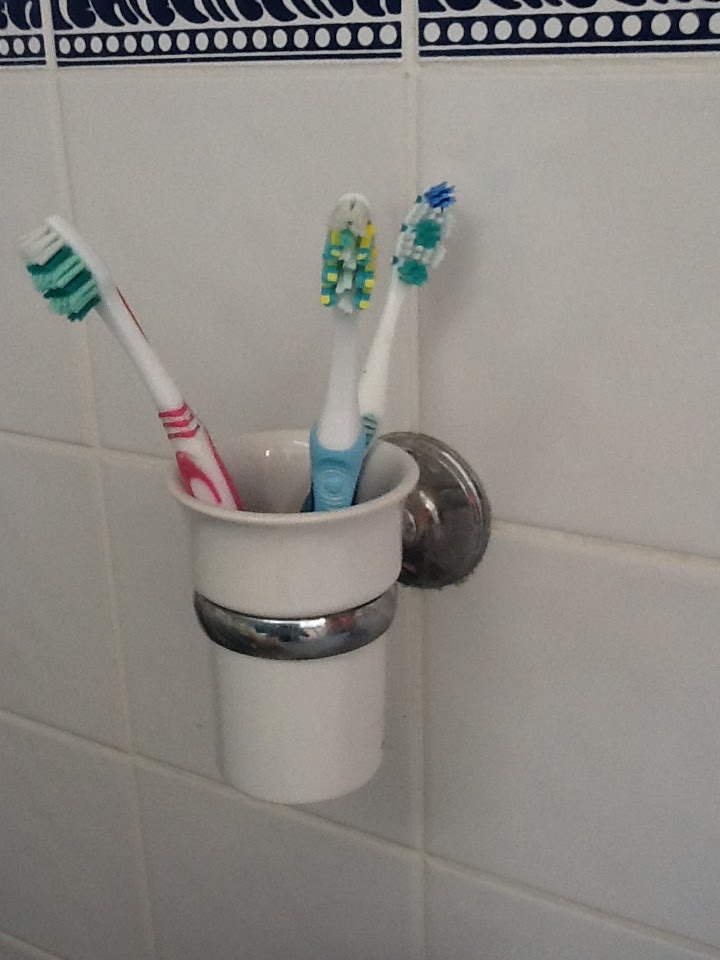
In my quest for advice and inspiration whilst trying to declutter my house, I came across some useful advice from Sheila Chandra which she calls the Toothbrush Principle. Sheila makes the point that however disorganised and cluttered your house may be, you never loose your toothbrush. The reason that you can find your toothbrush is because you have a very simple system - which is that you store it close to where you need it, and you always put it back there because it is easy to do so. You don't ever have to 'tidy up' your toothbrush because you have an easy, simple system which you automatically use.
So this very simple idea set me thinking. How could I apply the Toothbrush Principle to the places in my house where stuff regularly builds up?
One of the areas that I struggle to keep tidy is my bedroom. Every couple of weeks I have a big sort out and tidy and hoover, and for a day or so everything is beautifully calm and ordered. But within a few days, the clutter starts coming back. So why is this?
Well although in theory I like the idea that my bedroom is a calm relaxing space, the reality is that because it's a lovely big light airy room, I use it for a lot more than just sleeping. In particular, I tend to sit on my bed to read, write, check my finances & use my laptop. (As I am right now as I type this post.) So over time, I accumulate a pile of library books, notebooks, magazines etc beside the bed. Every so often I would sort them out & decide they should be somewhere else, but they always came back again. Now that the puppy is chewing everything within reach, stuff on the floor is even more of a problem.
So applying the toothbrush principle to this problem, I worked out what I needed was a small bookcase in the bedroom. I had a rootle through the garage and found the carcase of an old kitchen cabinet which I dusted off and lugged upstairs to serve as a temporary bookcase. Now all my library books and magazines have a place to go. And because it's in the bedroom, it's easy to quickly tidy away stuff when I've finished what I'm doing.
Now I know this might sound very simple (and that's the beauty of it) - so why didn't I think of this before?
Well, I had thought about putting a bookcase in the bedroom before, but I had resisted, because I felt like I shouldn't have lots of books and magazines in the bedroom, as we have a decent size house, so they should be in the study, or the book shelves in the living room. But applying the toothbrush principle worked, because I was being realistic about the way I actually used my bedroom rather than how I felt I should be using my bedroom, and provided storage that was easy to use and close to where it was needed.
Another area that quickly gets cluttered is my desk downstairs where I deal with my paperwork. Again I tried to apply the toothbrush principle and think what would actually help by being simple and easy, rather than implementing a complicated system that I wouldn't keep up. The problem here is that I tend to fling things on the desk that need dealing with when I'm busy, it all piles up and then I become more and more reluctant to deal with it.
Thinking about this I know that I need to try and tackle the paperwork more regularly, with a little and often approach, but what would help in the interim is to have a clearly defined, LARGE in-tray then smaller trays for action and filing. By providing enough space for incoming stuff, I am now able to keep it separate from stuff that is waiting for action. Previously it was all getting muddled and then I would end up with a big pile to go through every few weeks when I started to get a panicky feeling that there was probably something important in the middle that needed to be dealt with. So I labelled my existing small filing tray to create a section for action within a week, action within a month, and filing, then found a new bigger container to use as an In-tray. I put this new system in place a couple of weeks ago, and although I know I still have a bit of a backlog of stuff to deal with, I no longer feel the important items are getting lost and swamped by the volume of everyday mail, and I have a simple system in place that I am actually using.
So in the fight against clutter, the Toothbrush Principle is a useful tool. Be realistic about the way you operate, and use storage that is close to where you use things and easy to use.
Showing posts with label Clearing the clutter. Show all posts
Monday, 12 October 2015
Tuesday, 22 September 2015
The ultimate decluttering device - get a puppy.
![]() |
| The ultimate declutterer? |
Three weeks ago, we acquired a new 10 week old Cockapoo puppy. We had been considering getting a dog for quite a while, and having investigated different dog breeds, we had concluded that the family friendly gentle nature of a Cockapoo would suit us. Plus, we hoped she wouldn't try and eat the rabbit like a terrier would.
Having decided on a dog a while ago and having researched the breed, the next question was timing. We had a holiday planned in the summer, so I figured I could start looking as soon as we returned. A few days after we got back, I started the puppy hunt on Pets4homes, and found a gorgeous looking litter of black cockapoos about an hours drive from us. After exchanging emails and phone calls with the breeder, during which time we both decided the other sounded a responsible adult with high standards of puppy welfare, we eventually met and chose our puppy. Suddenly, after months of thinking about it and planning, we were about to become proud new puppy parents!
Great excitement, followed by the realisation that we needed to puppy proof our house. The day before we got her I found the previously lacking motivation to sort out the boot room at the back of the house. I both tidied and reorganised things so I could move the cat's food and bed up onto the counter in the utility to give her a safe haven out of the puppy's reach. In the rest of the house I have had to ensure that nothing is left on the floor or within easy reach. My pile of clothes that accumulates on a chair beside my bed is now scooped up on a regular basis and tidied away in case she gets hold of something precious. I once lived with a puppy that converted one of my handbags into a clutch bag, so I am taking no chances. The puppy was fairly quiet for the first few days, but now she has been with us for 3 weeks and well settled in she is trying to chew everything. I spend my days roaming the house with eagle eye trying to detect small tasty objects before she does, and wrestling them out a mouth full of needle sharp teeth when she gets there first.
The most exciting moment came after we had her a couple of days and my teenage daughter announced that she was going to tidy her room so that the puppy could come in to play. The carpet, once lost to view under a layer of teenage detritus was excavated and even hoovered. So in a few days our bouncy small bundle of fur achieved more than years of effort by a nagging mother.
So a puppy as a decluttering tool? Has its benefits - but she's not completely housetrained yet, so I think on balance she may create more chaos than we have achieved by tidying up. But our home is a bit tidier and more organised, and certainly a lot more fun!
Monday, 14 September 2015
Starting to clear the clutter
So I've decided to clear the clutter. Again. This isn't the first time I've tried to simplify things, so how do I go about it in a way that's more long lasting?
I love psychology, self help books and reading about how other people approach things in life. That's one of the reasons I started this blog, to join in the discussion rather than just watch from the sidelines. So I decided a good place to start on my quest to declutter would be to look for a good book on decluttering. Seeing as I'm not buying things I thought of heading to the library to see what I could find , but I decided to take a look on Amazon first. Although I wasn't intending to buy, the customer reviews were a good place to work out which books were useful, then I could use the online library catalogue to search for and reserve books. 'No More Clutter' by Sue Kay caught my eye and as they don't have a copy a my library, I have placed a reservation.
On looking further through the library catalogue, there seemed to be quite a few books about organising and decluttering available in my local library, so I headed down to see what I could find on the shelves. I discovered a wonderful gem of a book, 'The Clutter Cure' by Judi Culbertson. Rather than starting by focusing on how to declutter she instead starts by addressing the reasons why objects are meaningful to us, and why we find it so hard to let things go. I am already aware that we find it hard to let go of things because we perceive them to have value, or they have a sentimental attachment to them, or the person who gave them to us, but I have still found it hard to ignore those feelings at times. My particular weakness is that I can't bear to throw away something that might have a use for someone else. This makes it easy for me to sort through my clothes, because I can take the things I don't want to Oxfam where they will be sold and the money will go to fighting poverty, but really hard to get rid of something could be useful to someone else, but I don't know what to do with. This explains why a perfectly good but enormously large TV which has been sitting in our dining room for the last two months since we moved it out of another room to make space for an office for my husband. It's incredibly heavy as well as enormously large, and in the era of cheap flat screen TVs, I can't imagine anyone else wanting it, but I just can't bear to take it to the dump.
In the first few chapters of 'The Clutter Cure', Judi somehow manages to pinpoint all the sticking points as to why it's hard to let things go, and then gently chip away at them with both sensitivity and logic, to the point where it suddenly seems easy to let things go. By the time I was two chapters in, I was raring to go, and attacked my clothes drawers in the bedroom. Out went the 'useful' white T shirts which I don't wear any more and I don't feel good in. Out went the two 'useful' cardigans I hadn't worn for ages and a silk scarf I was given for a works event decades ago that I never wear. I also ditched the dresses that are a bit big on me since I lost weight last year and the lovely Joules dress that I bought from a charity shop and have worn once, but doesn't really fit right and it isn't really me. Yes, maybe I shouldn't have bought it in the first place, but it's cluttering up my wardrobe and now that it's gone, I'm not being reminded that I made a bad buy and feeling guilty that I've not worn it more.
That was yesterday evening, and today I've managed to sort through the large bookcase in our sitting room, and free up six bags of books and a bag of DVDs which can also go to Oxfam. I've got a slight sticking point on some books that are too scruffy for Oxfam and some magazines that someone else might like to read, but we have a festival starting in our village next week and there is a 'swap and swish' event where people can bring along things they don't need to give away, so I have bagged them up ready for that. I've also managed to sort and clean the shelves in my kitchen with my cookery books on, and freed up a few cookery books that I no longer use.
A great start, but now I'm exhausted, so it's time to stop and plan what to tackle next!
I love psychology, self help books and reading about how other people approach things in life. That's one of the reasons I started this blog, to join in the discussion rather than just watch from the sidelines. So I decided a good place to start on my quest to declutter would be to look for a good book on decluttering. Seeing as I'm not buying things I thought of heading to the library to see what I could find , but I decided to take a look on Amazon first. Although I wasn't intending to buy, the customer reviews were a good place to work out which books were useful, then I could use the online library catalogue to search for and reserve books. 'No More Clutter' by Sue Kay caught my eye and as they don't have a copy a my library, I have placed a reservation.
On looking further through the library catalogue, there seemed to be quite a few books about organising and decluttering available in my local library, so I headed down to see what I could find on the shelves. I discovered a wonderful gem of a book, 'The Clutter Cure' by Judi Culbertson. Rather than starting by focusing on how to declutter she instead starts by addressing the reasons why objects are meaningful to us, and why we find it so hard to let things go. I am already aware that we find it hard to let go of things because we perceive them to have value, or they have a sentimental attachment to them, or the person who gave them to us, but I have still found it hard to ignore those feelings at times. My particular weakness is that I can't bear to throw away something that might have a use for someone else. This makes it easy for me to sort through my clothes, because I can take the things I don't want to Oxfam where they will be sold and the money will go to fighting poverty, but really hard to get rid of something could be useful to someone else, but I don't know what to do with. This explains why a perfectly good but enormously large TV which has been sitting in our dining room for the last two months since we moved it out of another room to make space for an office for my husband. It's incredibly heavy as well as enormously large, and in the era of cheap flat screen TVs, I can't imagine anyone else wanting it, but I just can't bear to take it to the dump.
In the first few chapters of 'The Clutter Cure', Judi somehow manages to pinpoint all the sticking points as to why it's hard to let things go, and then gently chip away at them with both sensitivity and logic, to the point where it suddenly seems easy to let things go. By the time I was two chapters in, I was raring to go, and attacked my clothes drawers in the bedroom. Out went the 'useful' white T shirts which I don't wear any more and I don't feel good in. Out went the two 'useful' cardigans I hadn't worn for ages and a silk scarf I was given for a works event decades ago that I never wear. I also ditched the dresses that are a bit big on me since I lost weight last year and the lovely Joules dress that I bought from a charity shop and have worn once, but doesn't really fit right and it isn't really me. Yes, maybe I shouldn't have bought it in the first place, but it's cluttering up my wardrobe and now that it's gone, I'm not being reminded that I made a bad buy and feeling guilty that I've not worn it more.
That was yesterday evening, and today I've managed to sort through the large bookcase in our sitting room, and free up six bags of books and a bag of DVDs which can also go to Oxfam. I've got a slight sticking point on some books that are too scruffy for Oxfam and some magazines that someone else might like to read, but we have a festival starting in our village next week and there is a 'swap and swish' event where people can bring along things they don't need to give away, so I have bagged them up ready for that. I've also managed to sort and clean the shelves in my kitchen with my cookery books on, and freed up a few cookery books that I no longer use.
A great start, but now I'm exhausted, so it's time to stop and plan what to tackle next!
Sunday, 13 September 2015
The next challenge - how do I simplify further ?
Now that I'm a couple of weeks into my project and am not buying unnecessary stuff, I've been paying some attention to what is the next challenge for me.
Our house is always messy in places, and although I'd rather have a slightly chaotic but welcoming house than one that always looked like a show home, I do find it frustrating that as the kids get older, it doesn't seem to get any easier to keep things under control. When they were small I felt like I never had enough time to keep things under control. Now they are older and I have more time, there's a limit to how much of it I want to spend on tidying up after everyone else! There are certain areas where clutter builds up and when I'm wading through it, trying to sort things out, I find myself wondering why we have so much stuff in our lives.
A while ago I remember my father telling me about my grandmother's day looking after the house and family when he was young. They lived in a in a beautiful part of the Cotswolds in Gloucestershire. My grandfather worked as the gardener on a small estate and they lived in the gardener's cottage with their three boys.
It was a small house built in the 1920's. Two rooms downstairs and three bedrooms upstairs. The toilet was originally outside, but a large porch had been built over it and the coal store, so it wasn't quite so cold to go out there in the winter. The bath was plumbed into what was called 'the scullery room' next to a sink where they washed up. It had a large piece of wood or hard board which fitted on top so you could stack up the washing up on it, when you needed a bath you just moved the board out the way. At eight every morning after breakfast my grandfather would head out to work and my grandmother would get on with the housework. I'm guessing it was physically hard, there was a Rayburn cooker that also provided hot water to light, a fireplace to clean out, and washing to be done without a modern washing machine. My grandfather came back at 11 for bread and cheese, then at 1pm for a cooked lunch. But then after, she had cleared up my father said that 'the afternoon was her own'.
I remember thinking about this when my children were younger. I could easily spend a free afternoon going through my daughter's bedroom trying to sort her numerous toys into some sort of order. My dad and his brothers had a box of wooden blocks and cars that they played with. When playtime was over, it would take a maximum of five minutes to pick this up and the room was tidy again. So in the afternoon, my grandmother didn't spend all afternoon sorting the boys bedrooms. She went to the WI, or joined in with the village amateur dramatic group, or just sat down and read a book.
It's not that I think that life was better than ours. I'm guessing there would have been times when she was bored and felt cooped up living in a small village. I don't fancy having to finish the washing up before I could have a bath or clean my teeth. But it is interesting that with all our labour saving devices, we seem to have replaced the hard work of day to day living with being busy managing all the 'stuff' in our lives: physical clutter, paperwork, emails, information. Surely there has to be a better middle way. So I'm figuring that the next challenge for me is how to simplify things further to make more time for the fun and meaningful parts of life.
Our house is always messy in places, and although I'd rather have a slightly chaotic but welcoming house than one that always looked like a show home, I do find it frustrating that as the kids get older, it doesn't seem to get any easier to keep things under control. When they were small I felt like I never had enough time to keep things under control. Now they are older and I have more time, there's a limit to how much of it I want to spend on tidying up after everyone else! There are certain areas where clutter builds up and when I'm wading through it, trying to sort things out, I find myself wondering why we have so much stuff in our lives.
A while ago I remember my father telling me about my grandmother's day looking after the house and family when he was young. They lived in a in a beautiful part of the Cotswolds in Gloucestershire. My grandfather worked as the gardener on a small estate and they lived in the gardener's cottage with their three boys.
It was a small house built in the 1920's. Two rooms downstairs and three bedrooms upstairs. The toilet was originally outside, but a large porch had been built over it and the coal store, so it wasn't quite so cold to go out there in the winter. The bath was plumbed into what was called 'the scullery room' next to a sink where they washed up. It had a large piece of wood or hard board which fitted on top so you could stack up the washing up on it, when you needed a bath you just moved the board out the way. At eight every morning after breakfast my grandfather would head out to work and my grandmother would get on with the housework. I'm guessing it was physically hard, there was a Rayburn cooker that also provided hot water to light, a fireplace to clean out, and washing to be done without a modern washing machine. My grandfather came back at 11 for bread and cheese, then at 1pm for a cooked lunch. But then after, she had cleared up my father said that 'the afternoon was her own'.
I remember thinking about this when my children were younger. I could easily spend a free afternoon going through my daughter's bedroom trying to sort her numerous toys into some sort of order. My dad and his brothers had a box of wooden blocks and cars that they played with. When playtime was over, it would take a maximum of five minutes to pick this up and the room was tidy again. So in the afternoon, my grandmother didn't spend all afternoon sorting the boys bedrooms. She went to the WI, or joined in with the village amateur dramatic group, or just sat down and read a book.
It's not that I think that life was better than ours. I'm guessing there would have been times when she was bored and felt cooped up living in a small village. I don't fancy having to finish the washing up before I could have a bath or clean my teeth. But it is interesting that with all our labour saving devices, we seem to have replaced the hard work of day to day living with being busy managing all the 'stuff' in our lives: physical clutter, paperwork, emails, information. Surely there has to be a better middle way. So I'm figuring that the next challenge for me is how to simplify things further to make more time for the fun and meaningful parts of life.
Subscribe to:
Posts (Atom)
